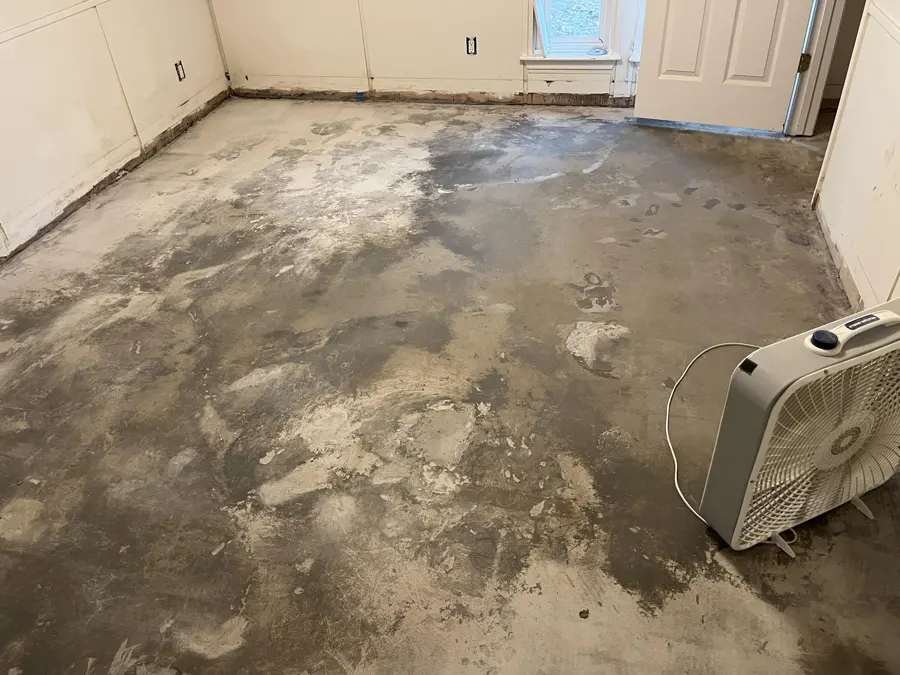
Aliso Viejo homes sit on slab-on-grade foundations with copper supply pipe, so two hidden leaks do most of the damage: a break in a pipe under the concrete and a pinhole in aging copper behind a wall. The two look different, dry differently and open up different parts of a house, which is why telling them apart early matters.
Key takeaways
- A slab leak sends water up through the concrete floor, while a pinhole leak usually starts inside a wall or ceiling and appears as a small stain.
- A water meter that keeps moving with every tap and appliance off points to a hidden supply leak somewhere on the property.
- Warm floor spots, the sound of running water and damp baseboards point toward the slab. A stain on drywall or a green crust on copper points toward a pinhole.
- Most homes in the city were built through the 1980s and 1990s, so copper that has carried water for decades is a normal suspect.
- The drying team opens a wall or lifts a floor only at the wet spot, then dries to a reading before anything is rebuilt.
Why two hidden leaks dominate in Aliso Viejo
The city was master-planned by the Mission Viejo Company, and the first homes sold in March 1982. Most of the city went up through the 1980s and 1990s, with newer villages such as Glenwood and Vantis following later.
Slab-on-grade foundations and copper supply pipe are the common pairing in that housing stock. Copper that has carried water for decades can corrode through at a spot no bigger than a pinhead, and a supply pipe under the concrete can fail where nobody can see it.
That is why pinhole leaks and slab leaks are the signature losses here, with water heater, supply hose and air handler leaks rounding out the list. A slab leak and a pinhole leak can both stay hidden for weeks.
Signs of a slab leak
A slab leak is a break in a supply pipe that runs under or inside the concrete. The water goes down first and then sideways, so it often reaches flooring before it reaches a wall.
Hot water pipes tend to give the earliest clue, because warm water heats the concrete above the break.
What the floor shows
- Warm spot: a patch of floor that feels warm underfoot can mean a hot water pipe is leaking beneath it.
- Damp or lifting flooring: carpet that stays wet, tile that sounds hollow or a plank that swells along a seam.
- Baseboards: moisture or staining along the bottom of a wall, often following the path of the pipe.
- Grout: dark grout or fresh cracks in one stretch of tile while the rest of the floor is dry.
What the meter and the bill show
Close every tap, make sure the dishwasher, washer and ice maker are idle, and read the water meter. If the dial or the small leak indicator keeps moving, water is leaving the system somewhere.
A bill that climbs with no change in habits, or the sound of running water when every fixture is off, points the same way.
Signs of a pinhole leak
A pinhole leak is a tiny hole in a copper pipe, usually inside a wall or ceiling. It weeps or sprays a small amount for a long time, so the damage can be far larger than the hole.
Insulation and the bottom of the drywall can be soaked long before a stain shows on the paint. These clues tend to appear first:
- Stain on drywall: a small brown or yellow patch that slowly grows or returns after painting.
- Green or white crust: mineral buildup on a copper pipe that is visible in a garage, closet or under a sink.
- Faint hissing: a quiet sound inside a wall when the house is still.
- Pressure drop: weaker flow at one fixture, or only on the hot side.
- Musty cabinet: a closed-in damp odor under a sink or in a closet.
Quick checks before anyone cuts into a wall or floor
These checks take little time and give the plumber and the drying team a head start.
- Meter test: read the water meter with every fixture off, wait through a quiet stretch, then read it again.
- Main shutoff: if the meter keeps moving or water is visible, close the main shutoff and open one low tap to relieve pressure.
- Water heater: look at the base of the tank and its connections, because a tank leak can pass for a slab leak.
- Photos: take wide and close pictures of the stain, the floor and the meter reading before anything is moved.
- Wet edges: mark the border of each wet area with tape and the date so any growth is easy to see.
What the dry-out looks like
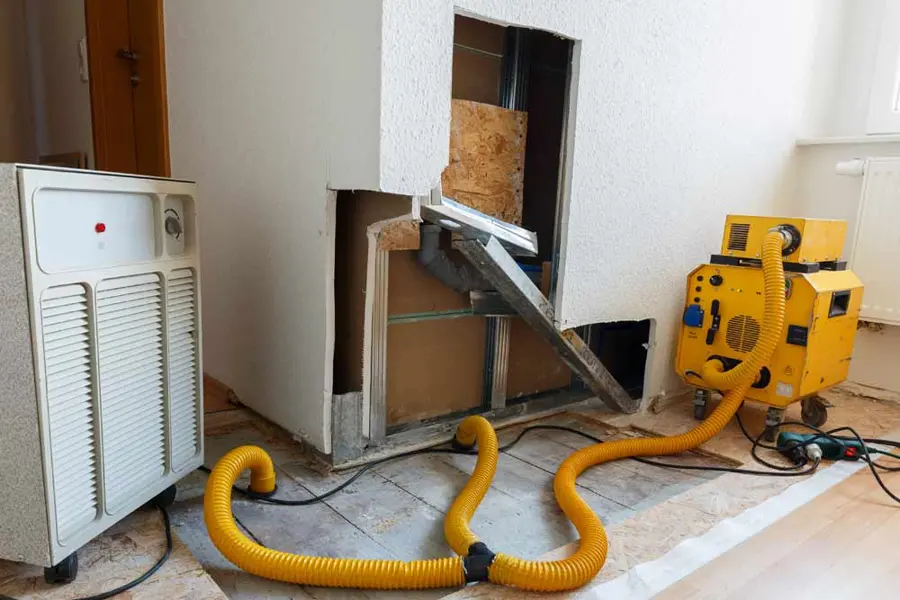
The restoration team starts with water extraction for any standing water, then maps the wet area with a moisture meter and a thermal camera. A floor or wall is opened only where the readings say it must be.
When the slab is wet
Flooring over the wet area is lifted so the concrete can breathe. Concrete releases water slowly, so LGR dehumidifiers and air movers usually run for several days.
When a wall or ceiling is wet
Drywall is cut at the wet spot and soaked insulation comes out. The cavity is dried with air movers, and board that stays wet is replaced instead of dried.
When the job is finished
Daily readings decide when the equipment stops, following the IICRC S500 standard. Structural drying ends when each material reads dry, not on a set date.
Who fixes the pipe and who dries the house
A plumber repairs or reroutes the failed pipe, and the restoration team dries the structure. The two jobs overlap, so the plumber should know where the walls and floor are already open.
In a townhome or condo, a leak can cross into the next home, so the neighbors and the association should hear about it early.
Repair choices run from a spot repair to rerouting the pipe through an attic or a wall, and the plumber makes that call.
Keep the photos, the meter readings and the drying log in one folder. They make the repair and the claim file easier to build.
Questions
How can a homeowner tell a slab leak from a leaking water heater?
Check the tank first. Water at the base, rust at the fittings or a dripping relief valve points to the heater. If the tank is dry and the meter still moves with every fixture off, the leak is somewhere else in the supply pipe, including under the slab.
Can a pinhole leak go unnoticed for months?
Yes. A tiny leak inside a wall can soak insulation and drywall slowly without ever making a puddle. A stain, a damp baseboard or a musty cabinet is often the first clue.
Does a slab leak always damage the flooring?
Not always, but water under a slab tends to find edges and joints and wick upward. Hardwood, laminate and carpet pad react first, and moisture readings decide what can stay.
How long does a wet slab take to dry?
It depends on how wet the concrete got and how long the water ran. Concrete gives up moisture slowly, so drying commonly takes several days and ends when readings match the dry reference.
Should the water be shut off at the main?
If the meter keeps moving or water is visible, yes. Closing the main stops new water while the leak is located, and a plumber can then isolate the failed section.