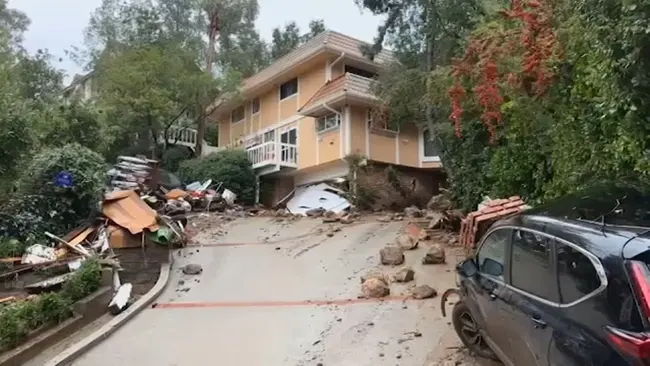
Storm water in Mission Viejo is more often a pooling problem than a roaring creek. In the mapped flood zones, ponding on parking lots, lawns and roads is the common pattern, and a foot of water in the wrong place is enough to wet a garage or a ground floor room.
Key takeaways
- FEMA maps the vast majority of the city as Zone X, and its 100-year flood zones lie mostly along the base of canyons and hills.
- Floodwater in the mapped 100-year and 500-year zones is expected to stay no deeper than one foot, with ponding on parking lots, lawns and roads the common pattern.
- Heavy rain comes between October and April, according to the city's hazard plan.
- Storm water from outside is treated as contaminated from the start, so porous materials that soaked it up are usually removed.
- Clearing drains, lifting stored items off garage floors and photographing the property before the rains start all shorten a cleanup.
What the flood maps and the city's hazard plan say
FEMA maps the vast majority of Mission Viejo as Zone X, and its 100-year flood zones lie mostly along the base of canyons and hills. Floodwater in the mapped 100-year and 500-year zones is expected to stay no deeper than one foot.
Oso Creek runs through the central part of the city, Arroyo Trabuco and Tijeras Canyon lie in the east, and Aliso Creek runs along the northwest boundary. Most of the city's creeks are not lined with concrete.
Most street runoff moves through local storm drains run by the city's Public Works department, with regional facilities owned by the Orange County Flood Control District. The city's hazard plan says heavy rain comes between October and April and that the hilly terrain keeps flood zones focused in particular places.
How ponding reaches a garage or ground floor room
Ponding forms where runoff comes faster than the drains can take it: low corners of parking lots, lawns that slope toward a building and gutters that back up. A foot of water is far more than a garage threshold or a patio door track can hold back.
- Garage door: water slips under the seal or over the threshold, then spreads across the slab.
- Patio and sliding doors: the track channels water straight onto carpet or flooring.
- Downspouts: a discharge aimed at the foundation sends water along the wall.
- Yard drains: a drain packed with leaves or mulch turns a lawn into a pond.
- Ground floor units: in a condo or apartment, water that crosses a patio threshold meets flooring first.
Why storm water is cleaned as contaminated water
Runoff crosses roads, parking lots and yards before it reaches a building. It collects soil, oil, fertilizer and debris, so storm water from outside is treated as Category 3 from the start.
That classification drives the work in storm and flash flood cleanup, where materials are sorted by how much water they soaked up.
Time matters because porous materials begin absorbing contaminated water right away. The longer carpet, pad and drywall sit in it, the less likely any of them can be saved.
- Porous materials: carpet, pad, insulation and drywall that stood in the water are usually removed.
- Hard surfaces: concrete, tile and sealed wood are cleaned, treated and dried.
- Stored items: cardboard, fabric and paper that wicked up the water are usually discarded.
- Safety: rubber boots and gloves, no household vacuum and no children in the water.
What past storms show
The local record shows how quickly a wet winter can turn a quiet street into a pond. It does not predict which address is next, and none of these accounts says a particular neighborhood flooded.
The same pattern runs across South Orange County, as covered under storm and flash flood cleanup in Aliso Viejo.
- February 1983: heavy rain flooded several Orange County streets. In Mission Viejo, 30 vehicles and a multi-family building were damaged.
- December 6 to 8, 1997: the heaviest rain in 70 years for parts of Orange County, with 4 to 8 inches widely and as much as 10 inches in the city.
- February 28 to March 1, 2014: a very wet storm brought minor street flooding to the city on March 1.
- November 20 to 21, 2025: the National Weather Service issued a flash flood warning covering the city, Aliso Viejo, Laguna Niguel, Laguna Hills and other Orange County communities.
- December 23, 2025: ahead of a Christmas storm, forecasters expected peak rainfall rates of 0.50 to 1 inch per hour.

Before the October to April rains
This work is small, and it changes what a cleanup has to remove.
- Drains and gutters: clear gutters, downspouts and yard drains so water leaves the property.
- Doors: check the garage door seal and the patio door track for gaps.
- Garage floor: lift boxes, paper and fabric onto shelves or racks.
- Shutoffs: find the main water shutoff and the electrical panel, and note the path to each.
- Before pictures: photograph the garage and the ground floor rooms so a later claim file has a starting point.
After water gets in
Water that crossed a threshold deserves a fast reaction even when it looks shallow. Carpet and pad wick moisture upward, and a few inches of standing water can soak the bottom of the drywall.
The first day
Stay out of standing water until the power to wet areas is off. Photograph how high the water reached on the walls and the condition of the flooring before anything is moved.
The dry-out
The restoration team starts with water extraction, removes what cannot be saved and dries the rest to a reading. storm and water damage restoration runs 24/7, including during storms.
The record
Readings for each wet material, photographs of what was removed and a written scope make up the file that an insurer or an association will ask for.
Questions
Is Mission Viejo in a flood zone?
FEMA maps the vast majority of the city as Zone X, with 100-year flood zones lying mostly along the base of canyons and hills. The zone for a specific address comes from FEMA's flood map, not from general statements about the city.
How deep does storm water get in the mapped zones?
Floodwater in the mapped 100-year and 500-year zones is expected to stay no deeper than one foot. Ponding on parking lots, lawns and roads is the common pattern.
Is storm water clean enough to mop up?
No. Storm water from outside carries soil, oil and debris and is treated as Category 3. Porous materials that soaked it up are usually removed, and hard surfaces are cleaned and treated.
Does ponding on a lawn mean a creek is overflowing?
Not necessarily. Ponding forms where runoff comes faster than storm drains can take it, which can happen far from any creek.
What should be moved out of a garage before heavy rain?
Anything that soaks up water: cardboard boxes, paper, fabric and wood. Lifting items onto shelves or racks keeps a few inches of water from ruining them.
How soon should wet carpet come out after a storm?
As soon as it can be done safely. Carpet and pad that soaked up storm water are usually removed, because contaminated water runs through them and cannot be cleaned out.